


Most local business owners start SEO expecting quick results.
That expectation usually comes from aggressive agency promises, YouTube ads, or stories about companies that “ranked in 30 days.” Then reality hits. Rankings move slowly. Google Maps visibility changes week to week. Calls increase one month, then flatten the next.
For many small businesses, this becomes frustrating fast.
The truth is that local SEO does work, but the timeline depends on competition, trust, reviews, website quality, consistency, and how strong the business already is online.
A local plumber in a small town may see movement within weeks. A dentist in a major city may need months before reaching the first page. Both are doing SEO. The environments are completely different.
This guide explains exactly how long local SEO takes, what affects ranking speed, what realistic progress looks like month by month, and why some businesses grow much faster than others.
If you are trying to understand whether SEO is worth the wait, this is the realistic timeline most agencies never explain clearly.
At a Glance
| Topic | Quick Answer |
|---|---|
| Average local SEO timeline | 3–6 months |
| Competitive industries | 6–12 months |
| Low competition markets | 2–4 months |
| Google Business Profile impact | Often fastest ranking improvement |
| Reviews important? | Yes, heavily |
| Paid ads faster? | Yes, but temporary |
| SEO permanent? | More sustainable long-term |
| Biggest ranking factor | Trust and relevance |
| Fastest local SEO wins | Maps optimization and reviews |
| Hardest rankings | Lawyers, dentists, real estate |
How Long Does Local SEO Take?
Most local businesses begin seeing measurable SEO improvements within 3 to 6 months.
That usually means:
- better Google Maps visibility,
- improved local keyword rankings,
- more website traffic,
- increased profile views,
- and more customer calls or direction requests.
In more competitive industries or large cities, strong rankings can take 6 to 12 months or longer.
Local SEO is not instant because Google needs time to evaluate trust, consistency, user behavior, reviews, content quality, and business relevance before pushing a company higher in search results.
What Is Local SEO?
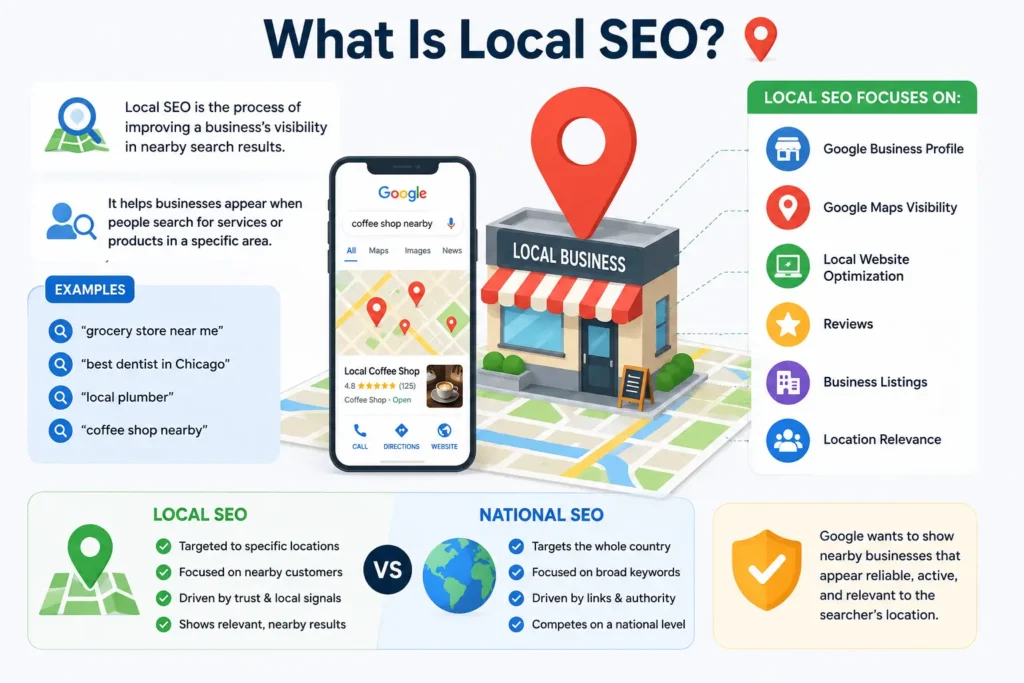
Local SEO is the process of improving a business’s visibility in nearby search results.
It helps businesses appear when people search for services or products in a specific area.
Examples include:
- “grocery store near me”
- “best dentist in Chicago”
- “local plumber”
- “coffee shop nearby”
Local SEO mainly focuses on:
- Google Business Profile,
- Google Maps visibility,
- local website optimization,
- reviews,
- business listings,
- and location relevance.
Unlike national SEO, local SEO is heavily connected to geography and trust signals.
Google wants to show nearby businesses that appear reliable, active, and relevant to the searcher’s location.
Why Local SEO Takes Longer Than Most Businesses Expect
One of the biggest misunderstandings in digital marketing is the belief that SEO works like advertising.
It does not.
Paid ads can appear immediately because businesses pay for placement. SEO works differently. Google must first trust the business before improving rankings consistently.
That trust develops over time.
Google evaluates:
- how accurate the business information is,
- whether customers engage with the listing,
- how often reviews appear,
- website quality,
- local relevance,
- backlinks,
- content freshness,
- and user behavior.
This process is gradual.
A business cannot usually publish a few pages and instantly outrank competitors that have built authority for years.
The Real Local SEO Timeline
Many local businesses also underestimate how fragmented local search visibility really is.
Ranking well for one keyword does not automatically mean ranking well across an entire city or service area.
A business may appear strongly for:
- “emergency plumber downtown”
but remain almost invisible for: - “24 hour plumber near airport”
or: - “water heater repair in west side.”
That is why local SEO campaigns often expand gradually instead of exploding overnight.
Google evaluates relevance at a highly localized level. Small geographic differences, search intent variations, and even mobile user proximity can influence rankings differently across neighborhoods.
This creates a slower but more layered growth pattern.
Another factor is data consistency across the wider local web ecosystem.
Google compares information from:
- business directories,
- review platforms,
- websites,
- map data,
- social profiles,
- and customer engagement signals.
If business details conflict across platforms, ranking progress can slow because trust signals become weaker.
Older businesses sometimes benefit here because they have accumulated years of mentions, reviews, and citations online. Newer businesses usually need more time to build that same digital footprint.
Local SEO also tends to compound.
The first few months are often the hardest because Google has limited engagement data. As more customers interact with the listing, leave reviews, visit pages, and search for the business directly, local authority can strengthen much faster than during the early stages.
This is one reason why businesses that remain consistent for 12 months often see dramatically stronger results than businesses that stop after 90 days.
First 30 Days of Local SEO
The first month is usually preparation and cleanup work.
This stage rarely produces dramatic ranking improvements immediately, but it creates the foundation that future rankings depend on.
Most local SEO campaigns start with:
- technical website fixes,
- Google Business Profile optimization,
- citation cleanup,
- keyword research,
- competitor analysis,
- mobile optimization,
- and review planning.
During this stage, Google may begin re-indexing parts of the website.
Some businesses see early visibility improvements in Google Maps, especially if the profile was poorly optimized before.
What Usually Happens in the First 30 Days
| SEO Activity | Typical Impact |
|---|---|
| Google Business Profile updates | Fast visibility improvements |
| Website technical fixes | Better indexing |
| Citation cleanup | Stronger consistency |
| New local pages | Improved relevance |
| Review strategy setup | Trust growth begins |
| Mobile optimization | Better user experience |
Many businesses mistake this stage as “nothing happening.”
In reality, this is where long-term local rankings are often built.
What Happens Between 30 and 60 Days?
This is where many businesses start noticing small movement.
Google may begin:
- ranking some pages for local searches,
- improving Maps visibility,
- increasing profile impressions,
- and showing the business for longer-tail keywords.
This period is often unstable.
Rankings may move up and down regularly while Google tests how users interact with the business.
Some local businesses panic during this stage because rankings fluctuate heavily.
That is normal.
Google is still evaluating trust signals.
What Happens Between 60 and 90 Days?
For lower competition industries, this is often where measurable SEO progress becomes visible.
Businesses may begin seeing:
- increased calls,
- more direction requests,
- more organic traffic,
- and better placement in local map packs.
This is also where review growth starts becoming more important.
A business with strong reviews and an optimized Google Business Profile can begin outperforming older competitors with weak customer engagement.
Typical SEO Changes After 90 Days
| Area | Common Improvement |
|---|---|
| Google Maps visibility | Moderate improvement |
| Website traffic | Noticeable increase |
| Branded searches | Higher frequency |
| Local keyword rankings | Better consistency |
| Customer calls | Gradual increase |
| Review engagement | More trust signals |
This stage often determines whether the strategy is working properly.
What Happens Between 3 and 6 Months?
This is where local SEO usually becomes more stable.
Businesses that consistently improve:
- content,
- reviews,
- citations,
- website quality,
- and local authority
often begin seeing stronger lead generation during this period.
For many local businesses, this is the first time SEO starts feeling financially worthwhile.
Rankings become less volatile.
Google gains more confidence in the business.
Local trust signals strengthen.
Businesses that stop SEO too early often miss this phase completely.
What Happens Between 6 and 12 Months?
In competitive markets, this is where stronger rankings usually develop.
Businesses may begin:
- ranking for highly competitive keywords,
- appearing more frequently in Maps,
- building stronger authority,
- and generating more predictable lead flow.
This stage is heavily connected to consistency.
Google favors businesses that continue improving over time.
Many companies plateau because they stop:
- updating content,
- generating reviews,
- improving pages,
- or maintaining local optimization.
SEO momentum slows quickly when businesses become inactive online.
Beyond 12 Months
This is where local SEO becomes a long-term business asset.
Businesses with strong local authority often experience:
- more stable rankings,
- lower advertising dependence,
- stronger brand recognition,
- and higher customer trust.
At this point, competitors usually need significant effort to overtake established local leaders.
That is one reason why older businesses with consistent SEO often dominate local search results for years.
Realistic SEO Timelines by Industry
Different industries move at completely different speeds.
Competition level matters enormously.
A local bakery does not compete the same way a law firm does.
Typical Local SEO Timelines by Industry
| Industry | Typical Timeline | Competition Level |
|---|---|---|
| Restaurant | 2–5 months | Medium |
| Local grocery store | 4–8 months | Medium |
| Plumber | 3–6 months | Medium |
| HVAC company | 4–8 months | High |
| Dentist | 6–12 months | High |
| Real estate agency | 8–14 months | Very High |
| Lawyer | 8–18 months | Extremely High |
| Coffee shop | 2–4 months | Medium |
| Local retailer | 3–6 months | Medium |
| Electrician | 4–7 months | High |
This is why comparing SEO timelines between businesses is usually misleading.
The market conditions are rarely equal.
Why Google Business Profile Matters So Much
For local businesses, Google Business Profile is often the fastest SEO win available.
An optimized profile can improve:
- Maps visibility,
- customer trust,
- click-through rates,
- and local engagement.
Many businesses ignore basic profile optimization.
That creates opportunities for competitors.
Important Google Business Profile Factors
| Ranking Signal | Importance |
|---|---|
| Accurate business information | Very High |
| Reviews | Very High |
| Photos | High |
| Business categories | High |
| Posting activity | Medium |
| Response rate | Medium |
| Keywords in description | Medium |
| Consistent updates | High |
Businesses with strong profile activity often outperform companies with better websites but weak local engagement.
Why Reviews Influence Local SEO So Strongly
Reviews are one of the clearest trust signals in local search.
Google wants businesses with:
- positive experiences,
- real customer engagement,
- and consistent activity.
Reviews influence:
- rankings,
- click-through rates,
- and customer confidence.
A business with 250 strong reviews usually appears more trustworthy than a competitor with 12 reviews and outdated information.
Review quality also matters.
Repeated fake reviews can create long-term trust issues.
How Competition Changes Everything
Local SEO in a small town is completely different from SEO in a major city.
Competition affects:
- ranking speed,
- authority requirements,
- review expectations,
- and content depth.
A roofing company in a town with five competitors may rank relatively quickly.
A roofing company in New York, London, or Toronto enters a completely different environment.
Competition Impact Table
| Market Type | Ranking Difficulty |
|---|---|
| Small town | Low |
| Mid-sized city | Medium |
| Major metro area | High |
| National local chains | Very High |
| Legal and finance sectors | Extremely High |
This is why realistic SEO expectations matter so much.