

Local SEO has changed dramatically over the last few years. Businesses are no longer competing only for traditional website rankings. They are competing for visibility inside Google Maps, mobile search, AI-generated local recommendations, and the local map pack that now appears for thousands of commercial searches every day.
That shift has made Google Business Profile one of the most important tools in modern search marketing.
For local businesses, service providers, retailers, restaurants, healthcare clinics, and multi-location brands, Google Business Profile can directly influence local rankings, customer trust, website traffic, and lead generation.
It also plays a major role in how Google understands local business entities, service relevance, and geographic authority.
Businesses that ignore Google Business Profile optimization often struggle to compete locally even when they have technically strong websites.
What Is Local SEO?
Local SEO is the process of improving a business’s visibility in geographically related search results on Google Search and Google Maps.
When users search for services near them, Google tries to show businesses that are relevant, trusted, and close to the search location.
Searches such as “supermarket near me,” “best dentist in Manchester,” or “local SEO agency in Chicago” usually trigger local results before standard organic listings.
This is where Google Business Profile becomes critical.
What Is Google Business Profile?
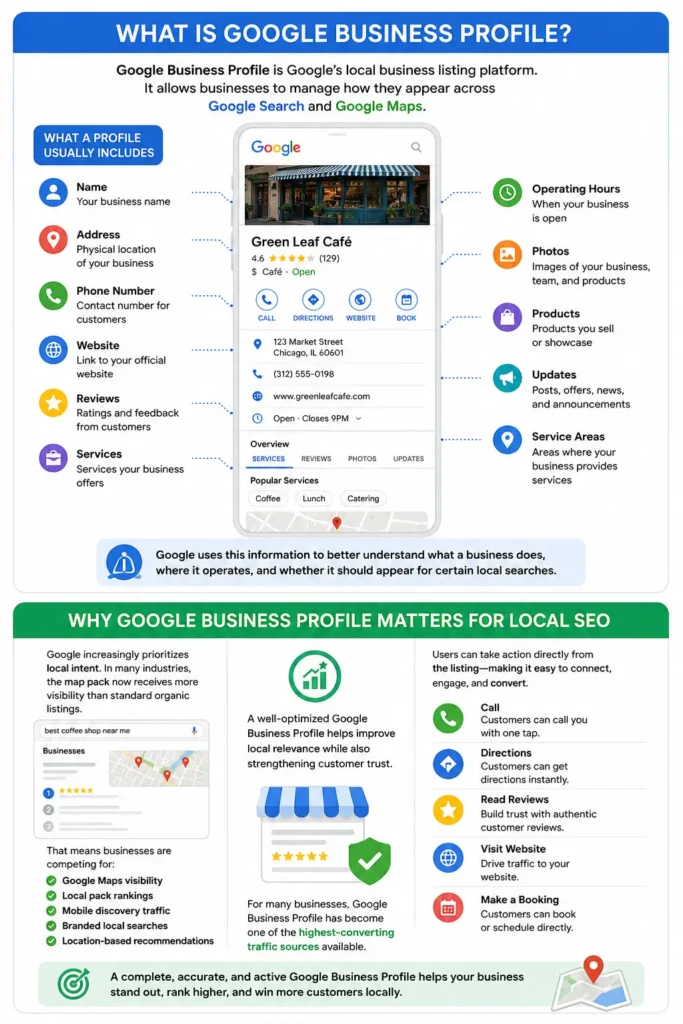
Google Business Profile is Google’s local business listing platform. It allows businesses to manage how they appear across Google Search and Google Maps.
A profile usually includes business information such as:
- name
- address
- phone number
- website
- reviews
- services
- operating hours
- photos
- products
- updates
- service areas
Google uses this information to better understand what a business does, where it operates, and whether it should appear for certain local searches.
Why Google Business Profile Matters for Local SEO
Google increasingly prioritizes local intent. In many industries, the map pack now receives more visibility than standard organic listings.
That means businesses are competing for:
- Google Maps visibility
- local pack rankings
- mobile discovery traffic
- branded local searches
- location-based recommendations
A well-optimized Google Business Profile helps improve local relevance while also strengthening customer trust.
For many businesses, Google Business Profile has become one of the highest-converting traffic sources available.
Users can now call a business, request directions, read reviews, visit a website, or make a booking directly from the listing itself.
How Google Determines Local Rankings
Google publicly states that local rankings are influenced mainly by relevance, distance, and prominence.
These three factors form the foundation of local SEO.
Relevance
Relevance measures how closely a business matches a user’s search query.
Google evaluates multiple signals to determine relevance, including:
- primary category
- secondary categories
- services
- website content
- reviews
- keywords
- business description
- topical authority
For example, a business focused on Google Business Profile reinstatement services is more likely to rank for suspension-related searches when both the profile and website clearly reinforce that specialization.
Google increasingly connects profile information with website content. Businesses that align their GBP optimization with their service pages often perform better locally.
Distance
Distance refers to how close the business is to the searcher or the target location in the query.
Google tries to show nearby businesses whenever possible, especially on mobile devices.
For service-area businesses, Google also evaluates:
- service area settings
- location consistency
- local citations
- geographic relevance
This is one reason why accurate business information across the web remains important.
Prominence
Prominence reflects how trusted and authoritative a business appears online.
Google evaluates signals such as:
- reviews
- local backlinks
- brand mentions
- media coverage
- website authority
- search demand
- customer engagement
Well-known local businesses often rank more consistently because Google sees stronger trust and behavioral signals connected to the brand.
How Google Business Profile Supports Website SEO
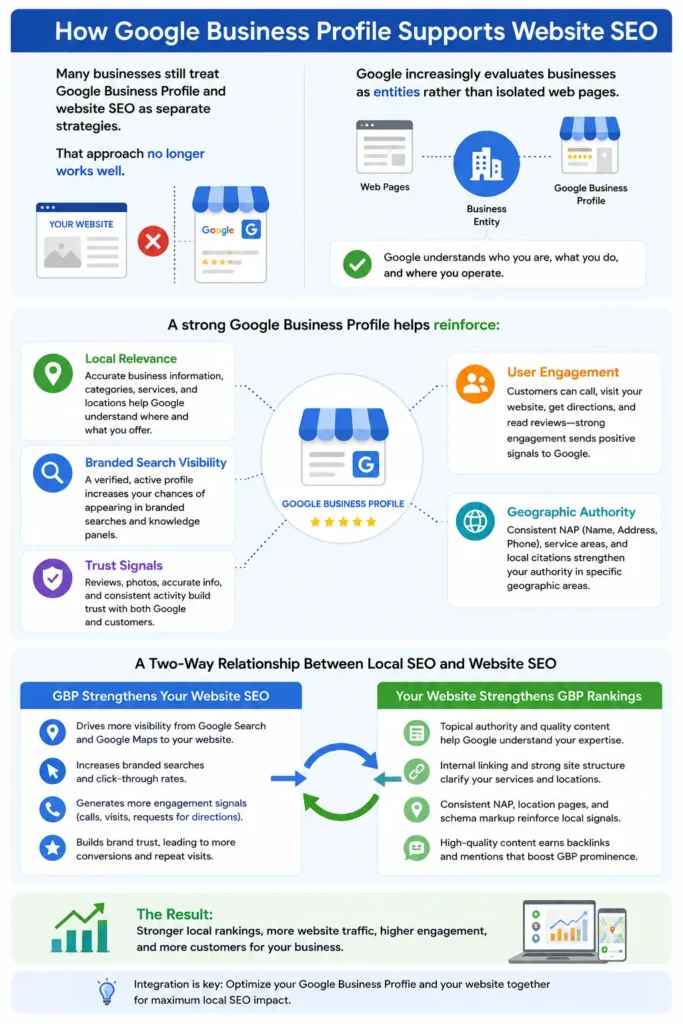
Many businesses still treat Google Business Profile and website SEO as separate strategies.
That approach no longer works well.
Google increasingly evaluates businesses as entities rather than isolated web pages.
A strong Business Profile helps reinforce:
- local relevance
- branded search visibility
- trust signals
- user engagement
- geographic authority
At the same time, strong websites strengthen GBP rankings through topical authority, service relevance, internal linking, and structured local content.
This creates a two-way relationship between local SEO and website SEO.
Why Service Pages Matter More Than Ever
One of the biggest local SEO opportunities in 2026 is aligning Google Business Profile optimization with focused service pages.
For example, businesses may create detailed pages around:
- GBP suspensions
- reinstatement services
- local SEO consulting
- review management
- citation cleanup
- spam policy recovery
When those topics are consistently connected across both the website and the Business Profile, Google gains stronger confidence in the company’s expertise.
This helps improve:
- service relevance
- local keyword rankings
- semantic authority
- topical trust
Instead of seeing disconnected pages, Google sees a complete local authority structure.
Why Reviews Influence Local SEO
Reviews are one of the strongest local ranking factors.
They influence not only rankings but also customer behavior.
Businesses with strong reviews usually generate:
- more clicks
- more calls
- more bookings
- higher trust
- better conversion rates
Google also uses reviews to better understand service quality and relevance.
Detailed reviews that naturally mention services or locations can strengthen topical associations around the business.
For example, reviews mentioning “Google Business Profile suspension help” or “local SEO support” reinforce those service connections naturally.
Fresh reviews also matter.
Inactive profiles with very old reviews often lose engagement momentum over time.
Why Categories Are Extremely Important
The primary business category is one of the most influential ranking factors inside Google Business Profile.
Choosing the wrong category can severely reduce visibility.
Google uses categories to understand:
- business type
- core services
- competitive relevance
- search intent alignment
Secondary categories help expand visibility into related services.
However, businesses should avoid category spam or misleading classifications because Google has become more aggressive with spam enforcement.
The Role of Photos and Profile Activity
Google wants active, trustworthy businesses inside local results.
Profiles with updated photos and regular activity often generate stronger engagement.
Businesses should regularly update:
- storefront photos
- team photos
- service photos
- product photos
- operational updates
Photo engagement may indirectly influence local visibility because Google tracks how users interact with business listings.
An active profile also signals legitimacy.
How Google Business Profile Posts Help SEO
Many businesses ignore GBP posts completely.
That is a missed opportunity.
Posts help reinforce:
- business activity
- service relevance
- promotions
- events
- local updates
They also improve engagement directly inside search results.
While posts alone may not dramatically improve rankings, they contribute to profile quality and customer interaction signals.
Why NAP Consistency Still Matters
NAP stands for:
- Name
- Address
- Phone number
Google cross-checks business information across the web to confirm legitimacy and consistency.
That includes:
- directories
- websites
- social platforms
- local citations
- industry listings
Inconsistent information creates confusion and weakens trust signals.
For example, businesses using multiple phone numbers or slightly different addresses across listings may struggle with local consistency.
Do Local Citations Still Matter?
Yes, local citations still matter in local SEO.
Their influence is not as dominant as it was years ago, but they still help validate business existence and geographic relevance.
Important citation sources include:
- Apple Maps
- Bing Places
- Yelp
- local directories
- trade associations
- chamber of commerce websites
Strong citation consistency helps reinforce entity trust.
How Google Uses Behavioral Signals
Google increasingly evaluates user interaction patterns.
These may include:
- click-through rates
- calls
- direction requests
- website visits
- review engagement
- photo interactions
Businesses that consistently generate stronger engagement often perform better in local search.
This reflects Google’s growing focus on user satisfaction and real-world usefulness.
The Growing Importance of Local Entities
Modern local SEO is heavily connected to entity understanding.
Google no longer relies only on keywords.
Instead, Google tries to understand:
- who the business is
- what it does
- where it operates
- how trusted it is
- which services it specializes in
Google Business Profile plays a major role in building those entity relationships.
When combined with strong local content and service pages, it strengthens semantic authority significantly.
Common Google Business Profile Mistakes
Many businesses damage their rankings without realizing it.
One of the most common problems is keyword stuffing inside the business name. While this tactic may produce temporary gains, it violates Google guidelines and can trigger suspensions.
Fake reviews are another major risk. Google’s spam systems have become far more aggressive, especially in competitive industries.
Duplicate listings also create problems because they confuse Google’s systems and weaken ranking consistency.
Some businesses also neglect profile activity entirely. Inactive profiles often lose visibility gradually over time.
Another common issue is inconsistent business information across directories and websites.
Why GBP Suspensions Have Become More Common
Google has increased enforcement against spam and manipulation.
Businesses may face suspensions because of:
- fake addresses
- virtual offices
- misleading edits
- category abuse
- suspicious review activity
- inaccurate information
A suspension can remove a business completely from Google Maps and local search results.
For companies heavily dependent on local traffic, this can cause immediate lead loss.
That is why reinstatement and GBP compliance have become major topics in local SEO.
How Multi-Location Businesses Handle GBP
Multi-location SEO requires a different strategy.
Each location should have:
- unique landing pages
- localized content
- separate reviews
- accurate local information
- location-specific optimization
Businesses that duplicate content across dozens of locations often struggle because Google prefers unique local relevance.
Strong multi-location SEO focuses on authentic geographic differentiation.
How AI Is Changing Local Search
AI-generated search results are changing how users discover local businesses.
Google increasingly uses AI systems to evaluate:
- trust
- topical relevance
- engagement patterns
- entity authority
- customer behavior
This means businesses relying on shortcuts or spam tactics are becoming easier to identify.
Long-term authority and authenticity now matter more than ever.
The Future of Google Business Profile SEO
Several trends are likely to shape local SEO over the next few years.
Google will continue strengthening entity-based ranking systems. Behavioral signals will likely become even more important as Google improves its understanding of user satisfaction.
Spam enforcement will probably increase further, especially in industries affected by fake listings and manipulated reviews.
At the same time, businesses with strong topical authority, trusted brands, and active customer engagement are likely to gain a larger advantage inside local search results.
Why Google Business Profile Is Now Central to Local SEO
Google Business Profile is no longer simply a local directory listing.
It has become one of Google’s primary systems for understanding local businesses, service relevance, and geographic authority.
A strong profile supports:
- local rankings
- customer trust
- website SEO
- map visibility
- service relevance
- local engagement
Businesses that combine GBP optimization with strong local content, service pages, and consistent authority signals usually perform far better in competitive local markets.
For companies already building authority around suspensions, reinstatement support, local SEO consulting, and review management, expanding into broader Google Business Profile optimization creates a stronger topical map and deeper search relevance across the entire site.
As local search continues evolving, Google Business Profile will likely remain one of the most important assets for businesses trying to compete in Google Maps and local organic rankings.