

How to REALLY Know If a Web Designer or Agency Is Good — Before You Spend a Penny
The Truth No One Tells UK Businesses
Buying a website in the UK is harder now than ever.
You’ll meet:
- freelancers
- small studios
- big agencies
- overseas teams
- template sellers
- “SEO experts” who don’t rank
- “WordPress experts” who break websites
- “branding consultants” who can’t write
- “web developers” who can’t design
- “web designers” who don’t understand SEO
And everyone says the same things:
- “Professional websites”
- “SEO included”
- “High-quality designs”
- “Fast delivery”
- “Best in the industry”
But here is the uncomfortable truth:
Most web designers and agencies cannot build a good website for themselves…
so how can they build one for you?
Before you trust any agency with your business:
✔ Check THEIR website
✔ Check THEIR portfolio
✔ Check THEIR speed
✔ Check THEIR content
✔ Check THEIR clarity
✔ Check THEIR SEO
✔ Check THEIR clients’ websites
✔ Test everything they claim
A website is not just about looking nice.
A good website must be:
- fast
- clear
- simple
- mobile-friendly
- structured
- technically correct
- content-driven
- easy to use
- error-free
- SEO-ready
- secure
Most agencies do NOT hit this standard.
This guide will show you exactly how to test them.
In simple English.
Step by step.
With zero jargon.
Most UK web designers fail one simple test:
their own website doesn’t meet the standards they sell to clients.
Here’s why:
1. They build for appearance, not performance
They choose templates, animations and heavy page builders that look good in screenshots but fail on speed, clarity and mobile usability.
2. They rely on cheap hosting
Slow £2/month hosting instantly destroys trust, rankings and user experience.
3. They ignore Google PageSpeed and Core Web Vitals
Not because they disagree with the metrics — but because they don’t know how to fix them.
4. They don’t understand SEO at all
Most web designers confuse “SEO-friendly pages” with simply “adding headings and text”.
Their own website proves it.
5. They cannot write clear content
If their homepage doesn’t communicate clearly, your website won’t either.
6. They use templates built for photos, not for real UK businesses
Many portfolios “look good” but collapse when you check speed, structure or mobile layout.
7. They never test their own work
No audits.
No PageSpeed tests.
No mobile checks.
No clarity checks.
No real UX thinking.
8. They never update their own website
If they won’t maintain their own site, they won’t maintain yours.
This is why the industry has so many disappointed customers —
the work doesn’t fail because clients are demanding.
It fails because designers don’t follow their own standards.
1. The First Test: Do You Even Like Their Website?
If you don’t like their website…
you will NOT like what they build for you.
Ask yourself:
- Is it clean?
- Is it modern?
- Is it relaxing to read?
- Is it simple to navigate?
- Are the headings clear?
- Is the spacing good?
- Does it feel professional?
If their own website feels messy or confusing,
your website will feel the same.
A web designer will never give you something BETTER than what they can do for themselves.
2. The 5-Second Test (Critical)
Open their website on your phone.
Give yourself five seconds.
Ask:
Can I understand what they offer instantly?
If you see:
- fancy animations
- sliders
- vague slogans
- confusing titles
- no clear message
- too many colours
…then they prioritised “looking clever” over “being clear.”
Clarity ALWAYS beats creativity.
A designer who cannot communicate clearly
cannot build a website that helps YOUR customers understand YOU.
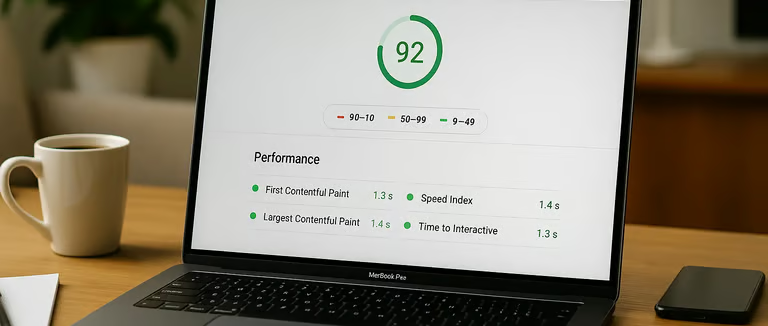
3. PageSpeed Test — The Fastest Way to Expose Bad Designers
Go to Google PageSpeed Insights.
Enter their homepage.
Check mobile score.
A good designer’s website:
- loads fast
- passes Core Web Vitals
- feels instant
- does not jump around
- has stable layout
- has small images
- is well-structured
Scores tell the truth:
- 90–100 = excellent
- 70–89 = acceptable
- 40–69 = poor
- 0–39 = unacceptable
If a web designer cannot build a fast website for themselves…
they absolutely cannot build one for their clients.
Website speed affects:
- SEO
- Google ranking
- conversion rates
- user trust
- bounce rates
- advertising cost
Speed is not optional anymore.
4. Check Their Website on Semrush or Any SEO Tool
You don’t need to be technical.
Just run the audit.
Look for:
- errors
- warnings
- broken links
- missing metadata
- missing headings
- slow load time
- huge image files
- unnecessary scripts
- accessibility issues
- duplicate content
If a designer says they “do SEO”
but their own site is FULL of SEO issues…
…what do you think they will deliver for you?
A professional keeps their own house clean.
5. Test Their Portfolio — But Ignore the Pretty Pictures
Screenshots are meaningless.
You MUST visit the real client websites they built.
Then check:
✔ Speed
✔ Clarity
✔ Structure
✔ Content
✔ Mobile view
✔ Functionality
✔ Typography
✔ Menu
✔ Spacing
✔ Errors
✔ Loading behaviour
The portfolio is the truth.
Most agencies show:
- pretty mockups
- template examples
- projects they didn’t fully build
- half-truths
- images only
But the LIVE website reveals:
- how they build
- how they optimise
- how they write content
- how they structure pages
- how they design for mobile
- how they handle real business needs
Never trust a screenshot.
ALWAYS test the real site.
6. Check the Speed of Their Clients’ Websites
This is the most powerful test of all.
Run their clients’ sites through PageSpeed:
If ALL of them are slow?
That is the designer’s real standard.
Anyone can make a pretty homepage.
A real expert builds:
- speed
- stability
- clarity
- consistency
- structure
- performance
If every portfolio site loads slowly or looks broken…
that tells you everything you need to know.
7. Check the Clarity of Their Content (This Exposes 99% of Designers)
Most agencies write:
- vague slogans
- empty promises
- buzzwords
- unclear messages
A website’s content should be:
- simple
- direct
- human
- helpful
- clear
- easy to understand
- free from jargon
Ask yourself:
“Do I understand what they’re offering without thinking?”
If the answer is no,
walk away.
Because your customers will feel the same on YOUR website if they build it.
8. Do They Have REAL Helpful Articles?
A real expert teaches.
A fake expert sells fluff.
Check if the agency has:
- guides
- educational posts
- SEO explanations
- speed tutorials
- writing advice
- buying guides
- web strategy
- performance advice
- case studies
If their blog is:
- empty
- short
- generic
- AI-sounding
- full of buzzwords
- low-effort
That tells you EXACTLY what they will deliver.
Real expertise shows in writing.
9. Check Their Website Structure (This Shows Skill Level Immediately)
Look for:
- clear headings
- clean URLs
- simple layout
- logical flow
- consistent spacing
- readable fonts
- good colour use
- strong mobile layout
- no clutter
- no chaos
If their structure is messy,
your website will be messy too.
10. Check Their Hosting (This Part Is Hidden but Important)
A designer who uses:
- cheap £1/month hosting
- free hosting
- slow shared hosting
…does NOT take performance seriously.
Good designers use:
- reliable servers
- CDN
- caching
- secure environments
Ask them:
“What hosting do you use for your own website?”
If their hosting is slow,
your website will be slow.
11. Check How They Talk About SEO (Fake Experts Reveal Themselves Quickly)
A real SEO-aware designer explains:
- how keywords work
- how to structure pages
- how to use headings
- why internal links matter
- how Google reads content
- why speed affects ranking
- how mobile UX affects SEO
- why clarity matters
A fake SEO designer says:
- “Basic SEO included”
- “SEO-friendly website”
- “We do SEO as standard”
…with NO explanation.
Real SEO is work.
Work shows in writing.
12. Check How They Present Their Prices
A good designer is:
- open
- clear
- honest
- transparent
A bad designer:
- is vague
- hides details
- says “depends” without explanation
- gives unrealistic low prices
- includes no breakdown
You are not just buying a website.
You are buying:
- clarity
- communication
- structure
- support
- updates
- reliability
Cheap designers often cost you MORE in the long run.
13. Check How They Communicate With YOU
Good communication feels:
- simple
- friendly
- calm
- clear
- reliable
Poor communication feels:
- rushed
- chaotic
- unclear
- defensive
- confusing
- disrespectful
The way they treat YOU
before you pay
is exactly how they will treat you
after you pay.
14. Check If They Have Real Examples of Writing, Not Just Design
A good website isn’t just visuals.
It requires:
- headlines
- sub-headlines
- content structure
- calls to action
- service descriptions
- FAQs
- internal linking
- metadata
Most designers cannot write.
Most SEO agencies cannot write.
Most content writers cannot write clearly.
If they cannot write well on their OWN website,
they cannot write well for yours.
15. Check Their Clients’ Google Ranking (Simple Test)
Pick one of their clients.
Search:
- business type + town
- service + location
- service + near me
If NONE of their clients rank anywhere…
Then their websites are not helping businesses.
A designer cannot control ranking fully.
But they CAN build:
- clear URLs
- strong content
- proper structure
- internal links
- metadata
- fast load time
If all clients perform poorly,
this is a problem.
16. Red Flags You Should Walk Away From Immediately
If you see ANY of these, leave:
- their own website is slow
- their website has errors
- content is weak or robotic
- confusing homepage
- messy design
- outdated look
- no blog or guides
- portfolio sites load slowly
- unrealistic low pricing
- vague promises
- no clear process
- hard to contact
- no mention of support
- hidden costs
- “guaranteed Google ranking”
- heavy animations
- template look
- missing SSL
- broken links
- poor mobile layout
You deserve better.
17. What a Truly Good Web Designer or Agency Looks Like
A good designer:
Has a fast website
Has clear content
Has a simple structure
Has strong writing
Has clean mobile UX
Has real client work
Has no technical errors
Has an honest process
Has transparent pricing
Has educational guides
Has consistent quality
Has clients who stay
Has clients who rank
A good designer’s own website
is the clearest evidence of their real ability.
18. Final Message: Your Website Is Your Shop Window — Choose Wisely
A website is not just:
- pretty colours
- templates
- branding
- pages
It is:
- your communication
- your reputation
- your speed
- your clarity
- your Google ranking
- your user experience
- your lead generator
- your trust builder
A designer who cannot deliver these things for themselves
will not deliver them for you.
Choose someone who leads by example.
Choose someone whose own website proves their skill.
Choose someone who writes clearly.
Choose someone who builds fast websites.
Choose someone who actually cares about performance.
Choose someone who educates, not confuses.
Choose someone who can explain everything in simple English.
If their website feels right,
your website will too.